Revisiting Node Affinity Prediction in Temporal Graphs
Authored by Or Feldman, Krishna Sri Ipsit Mantri, Moshe Eliasof, Chaim Baskin
Published in The Fourteenth International Conference on Learning Representations (ICLR) 2026
Abstract
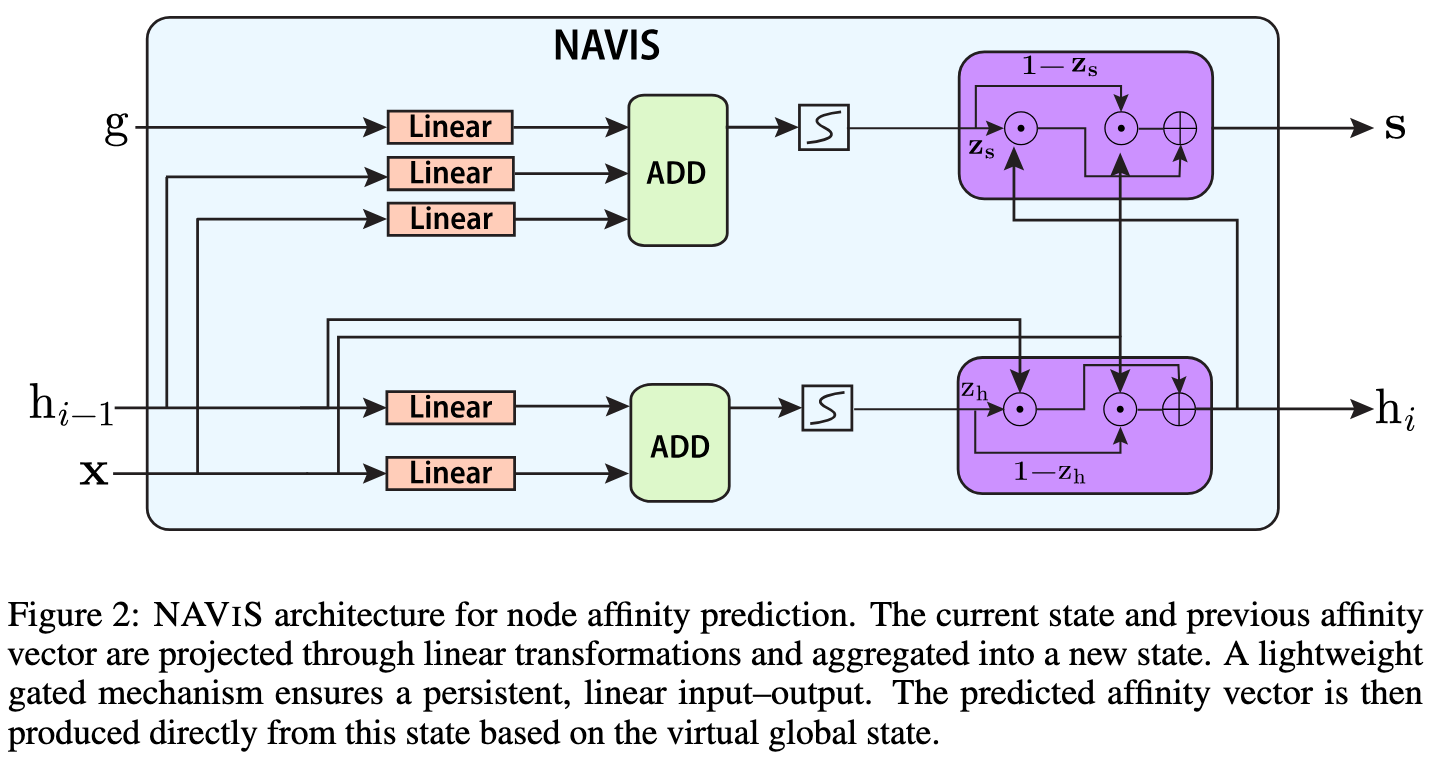
Node affinity prediction is a common task that is widely used in temporal graph learning with applications in social and financial networks, recommender systems, and more. Recent works have addressed this task by adapting state-of-the-art dynamic link property prediction models to node affinity prediction. However, simple heuristics, such as persistent forecast or moving average, outperform these models. In this work, we analyze the challenges in training current Temporal Graph Neural Networks for node affinity prediction and suggest appropriate solutions. Combining the solutions, we develop NAVIS - Node Affinity prediction model using VIrtual State, by exploiting the equivalence between heuristics and state space models. While promising, training NAVIS is non-trivial. Therefore, we further introduce a novel loss function for node affinity prediction. We evaluate NAVIS on TGB and show that it outperforms the state of the art, including heuristics.
Resources
Or Feldman and Krishna Sri Ipsit Mantri contributed equally. Work was done while Ipsit was interning at INSIGHT Lab, Ben-Gurion University.
Bibtex
    @inproceedings{ mantri2026revisiting,
    		author 	= { Or Feldman and Krishna Sri Ipsit Mantri and Moshe Eliasof and Chaim Baskin },
        	title 	= { Revisiting Node Affinity Prediction in Temporal Graphs },
       		booktitle = { The Fourteenth International Conference on Learning Representations (ICLR) },
        	year 	= { 2026 },
    	}